
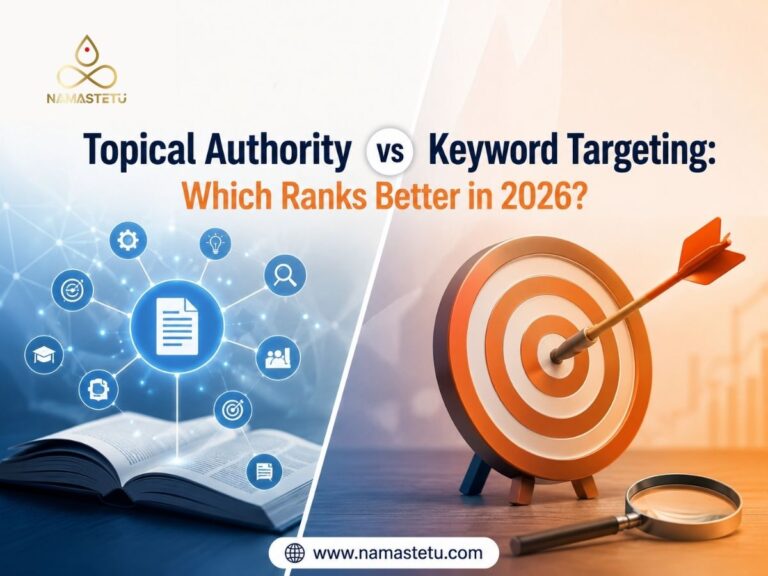
For years, SEO meant picking a keyword and building a page around it. That approach still works for quick wins, but it is no longer enough on its own, which is why more businesses now search for SEO Services in Indore that understand how to build topical authority, not just chase individual rankings.
What Is Topical Authority in SEO?
Topical relevance and topical authority describe how completely a website covers a subject, rather than how well a single page targets one term. A site earns this authority by publishing a connected set of articles that together answer nearly every important question within a specific field.
Google increasingly treats sites with strong topical coverage as trusted sources, rewarding them with faster indexing and more stable rankings. This is the foundation any modern best digital marketing agency Indore businesses work with should be building into every content plan.
What Is Keyword Targeting, and Why Does It Still Matter?
Keyword targeting optimizes a single page to match one specific search query, aiming to rank that page as high as possible for that term alone. This approach can win a position within weeks, making it useful for high-intent, transactional pages where speed matters more than long-term depth.
The limitation is that keyword-targeted pages often exist in isolation, without connecting to a broader body of content. Each page succeeds or fails largely on its own, without building cumulative authority across a wider subject area.
The Data: Which Strategy Actually Wins in 2026?
Independent research now quantifies the difference between these two approaches directly. Search Atlas analyzed more than SEO campaigns and found that sites focusing on topical authority first saw ranking gains up to 3 times faster than sites relying primarily on domain authority and backlink acquisition.
| Factor | Keyword Targeting | Topical Authority |
| Speed to first ranking | Fast, often within weeks | Slower, typically 3 to 4 months |
| Stability after algorithm updates | Less stable, ranking can drop suddenly | More stable, resistant to volatility |
| New content indexing speed | Standard indexing timelines | Often indexed within days |
| Long-tail visibility | Requires targeting each term individually | Improves automatically as authority grows |
| AI Overview and citation visibility | Limited, unless individually optimized | Stronger, due to comprehensive coverage |
This table reflects a consistent pattern across the research: keyword targeting wins on speed, while topical authority wins on durability and long-term compounding value.
Content Authority: What Google Actually Looks For
Content Authority is built through depth, not volume alone. Google evaluates whether a site goes beyond simple definitions, covering a subject with the kind of detail that demonstrates real expertise rather than surface-level coverage.
Two of the clearest signals of growing content authority are faster crawl rates for new pages and stronger engagement metrics, such as longer time on page and lower bounce rates. Both signals tell Google that a site has earned genuine trust on a topic, not just optimized individual pages for specific terms.
Search Intent Optimization: Matching Content to What Users Actually Need
Search intent optimization means building content around what a searcher actually wants to accomplish, not just the exact words they typed into Google. A page optimized purely for a keyword, without addressing the real intent behind that search, often underperforms even when it ranks initially.
This is where combining both strategies works best. Keyword research reveals the exact terms people use, while topical authority ensures the surrounding content fully satisfies the intent behind those terms, not just the literal phrase.
Semantic SEO: Why Meaning Matters More Than Exact-Match Keywords
Semantic SEO focuses on the relationships between concepts and entities within a topic, rather than repeating an exact keyword phrase throughout a page. Search engines now understand synonyms, related concepts, and context well enough that exact-match keyword density matters far less than it once did.
Marketing Companies in Indore business partners should build content using this understanding, covering related subtopics naturally instead of repeating the same phrase mechanically throughout a page.
AI Search Optimization: Why Topical Depth Wins Citations
AI Search Optimization increasingly favors topical authority over isolated keyword-targeted pages. AI Overviews and generative search tools tend to cite sources that demonstrate comprehensive coverage of a subject, since that depth signals reliability more clearly than a single well-optimized page ever could.
This is one of the strongest arguments for building topical authority now, since AI citation increasingly functions as the new equivalent of ranking in position one on a traditional search results page.
Topical Authority Strategy: How to Build It Step by Step
Building a Topical Authority Strategy requires a structured approach rather than publishing content randomly around a general subject. Here is the practical sequence that produces the most reliable results:
- Define a clear primary topic and map out every important subtopic within it.
- Build one comprehensive pillar page covering the topic at a high level.
- Create supporting cluster articles addressing each specific subtopic in depth.
- Interlink pillar and cluster pages logically, so search engines understand the hierarchy.
- Publish consistently, since most sites see measurable improvement after 3 to 4 months of steady output.
Keyword Targeting Strategy: When to Use It First
A Keyword targeting strategy still makes sense as the opening move for specific, high-intent pages, especially transactional pages where a business needs visibility quickly. Practitioners increasingly recommend using keyword targeting to land initial rankings, then shifting effort toward topical depth to hold and expand that position over time.
This sequencing matters because topical authority takes longer to build, but individual keyword wins can generate leads while that longer-term foundation is still being built.
Modern SEO Techniques: Combining Both Approaches
The strongest Modern SEO techniques in 2026 do not treat topical authority and keyword targeting as competing strategies. Instead, keyword research identifies which subtopics and terms to prioritize, while topical authority ensures that coverage compounds into a trusted, comprehensive resource over time.
A SEO Services in Indore provider that only offers one approach is likely leaving results on the table, since the two strategies genuinely work better together than either does alone.
Content Marketing Strategy: Structuring Clusters That Actually Work
A well-built Content Marketing Strategy organizes content into clear pillar-and-cluster structures rather than a scattered collection of unrelated posts. Each supporting article should link upward to a relevant pillar page, while pillar pages reference key supporting content where it adds genuine value for the reader.
This structure does more than help search engines understand a site’s focus. It also gives readers a clear path to explore a subject in depth, which naturally improves the engagement signals that reinforce topical authority further.
Search Engine Ranking Factors: What Still Matters Most
Among all Search engine ranking factors, comprehensive topical coverage, search intent alignment, and content depth now weigh more heavily than exact-match keyword density ever did. Backlinks and technical SEO still matter, but they support authority rather than substitute for genuine subject expertise.
Businesses that focus purely on backlink acquisition without building topical depth often see slower, less stable results compared to those investing in comprehensive content clusters first.
An Original Framework: The Authority-First Sequencing Model
Our team uses a simple internal framework when planning a new content strategy for clients, which we call the Authority-First Sequencing Model:
- Foundation Stage: Identify 3 to 5 high-intent keywords to target immediately for fast visibility.
- Expansion Stage: Build out 20 to 30 interlinked cluster articles covering the full topic comprehensively.
- Compounding Stage: Monitor which long-tail terms begin ranking automatically as authority grows, then reinvest in the strongest performing subtopics.
This sequencing captures early wins from keyword targeting while building the durable topical foundation that holds rankings through algorithm updates.
Common Mistakes Businesses Make With Either Strategy
- Publishing isolated, unconnected pages purely to chase individual keyword rankings.
- Building broad topical content without any keyword research guiding which subtopics matter most.
- Ignoring internal linking, which is essential infrastructure for demonstrating topical authority to search engines.
- Expecting topical authority results within weeks, when most sites need 3 to 4 months of consistent publishing to see measurable gains.
- Choosing a best digital marketing agency Indore provider that only understands one of these two strategies, rather than how to combine them effectively.
Frequently Asked Questions
1. Is topical authority better than keyword targeting for SEO in 2026?
Both matter, but for different reasons. Keyword targeting wins fast, specific rankings quickly, while topical authority builds long-term, stable visibility that survives algorithm updates. The strongest strategy in 2026 combines both, using keyword research to guide comprehensive topical coverage over time.
2. How long does it take to build topical authority?
Most sites begin seeing measurable ranking improvements after 3 to 4 months of consistent, focused publishing within a specific topic cluster. This timeline can vary depending on competition, existing site authority, and how comprehensively the content covers every important subtopic within the subject.
3. Does topical authority help with AI Overview citations?
Yes. AI Overviews and generative search tools tend to cite sources demonstrating comprehensive subject coverage, since that depth signals reliability more clearly than a single optimized page. Building topical authority increasingly functions as a direct strategy for improving AI citation visibility.
4. Should small businesses focus on keyword targeting or topical authority first?
Small businesses often benefit from targeting a few high-intent keywords first for quick visibility and leads, then expanding into topical authority once initial pages are ranking. This sequencing balances immediate results with the long-term stability that topical depth provides over time.
5. How many articles are needed to build topical authority on a subject?
Research suggests building at least 25 to 30 high-quality, interlinked articles within a single content cluster before expecting strong topical authority signals. Fewer articles can still help, but comprehensive coverage across the full subject area produces the most reliable, lasting results.
6. Does keyword density still matter for SEO rankings in 2026?
Not in the way it once did. Search engines now understand synonyms, related concepts, and semantic relationships well enough that natural, varied language matters more than repeating an exact keyword phrase throughout a page multiple times.
7. What role do backlinks play if topical authority matters more now?
Backlinks still support rankings, but they work best alongside strong topical coverage rather than as a replacement for it. Sites combining genuine subject depth with quality backlinks tend to outperform those relying heavily on link building without comprehensive content behind it.
8. Can a new website with low domain authority outrank established competitors?
Yes, documented cases show newer sites with minimal domain authority outranking established competitors within months by building comprehensive topical coverage. Genuine subject depth and interlinked content clusters can outweigh domain authority advantages that older, less focused competitor sites hold.
Conclusion:
In 2026, successful SEO is no longer about choosing between keyword targeting and topical authority—it is about combining both into a unified strategy. While keyword targeting delivers faster visibility for high-intent searches, topical authority builds long-term trust, stable rankings, and greater AI search visibility. Businesses that create comprehensive, interconnected content are more likely to earn higher rankings, AI citations, and sustained organic traffic. Partnering with experienced SEO Services in Indore ensures your content strategy aligns with evolving search engine algorithms and user intent. By balancing quick wins with long-term authority, businesses can achieve stronger search performance, better engagement, and lasting digital growth.