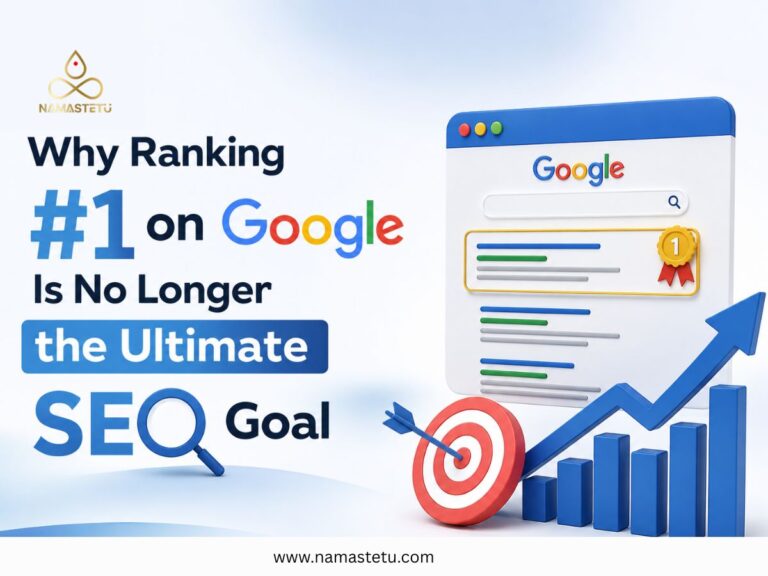
For years, every SEO Company in Indore measured success one way: get the client’s website to position one on Google. That single number decided budgets, reports, and reputations. But something has changed permanently in how people search, and it means rank alone no longer tells the full story of whether a business is actually being found.
What Changed: Google Search Visibility in the AI Search Era
Google introduced AI Overviews broadly in 2024, and by early 2026 they were appearing on roughly 48% of tracked search queries, according to BrightEdge’s ongoing tracking study. That is a 58% jump in just one year. When an AI Overview appears above the organic results, it answers the user’s question directly on the search page, using content pulled from multiple websites without requiring a click.
This is the core reason Google ranking factors alone are not enough anymore. A page can rank #1 in the traditional organic list and still receive a fraction of the clicks it would have earned two years ago, because the AI summary above it already gave the user their answer.
The Real Data: How AI Overviews Are Changing Organic Search Performance
The numbers here are not theoretical. Multiple independent research teams have measured the same pattern using real Google Search Console data.
| Study | Finding |
| Ahrefs (300,000 keywords, GSC data) | Position-one organic clicks drop by roughly 34.5% when an AI Overview is present |
| Pew Research Center (68,879 real searches) | Only about 8% of visits to a page with an AI summary led to a further click, versus around 15% without one |
| BrightEdge (9 industries tracked) | AI Overviews now appear on close to half of all tracked search queries |
| Seer Interactive (25.1 million impressions, 42 organizations) | Organic click-through rate fell as much as 61% on informational queries showing an AI Overview |
Read together, these numbers point to one conclusion: organic search performance can no longer be judged by rank position alone. A business ranking #1 for a competitive term might still be losing real visitors to the AI Overview sitting above it.
Why User Search Intent Matters More Than Position One
Google’s own ranking systems have shifted toward rewarding pages that fully satisfy user search intent, not just pages with the most backlinks or keyword repetitions. If someone searches a broad question, Google increasingly tries to answer it directly. If someone searches with clear commercial or local intent, such as “book a consultation” or “near me,” organic and map results still drive real clicks.
This is exactly why smart SEO Services in Indore providers are shifting strategy: instead of chasing every keyword for position one, they map out which searches still send genuine traffic, and which ones Google is likely to answer itself. Trying to rank #1 for a purely informational, single-word query is often wasted effort in 2026.
Google Ranking Factors That Still Matter in 2026
Ranking still matters, just not in isolation. Here is what continues to move the needle for real organic traffic growth:
- Topical depth and expertise — content that fully answers a question, written by someone with real experience in the subject.
- Page experience and speed — Google still rewards fast, mobile-friendly pages.
- Structured data and schema — this is what helps a page get pulled into AI Overviews and rich results in the first place.
- Backlinks from relevant, trustworthy sites — links remain one of the strongest trust signals Google uses.
- Freshness on time-sensitive topics — regularly updated content on evolving subjects performs better in both organic and AI results.
None of these factors disappeared. What changed is that hitting them no longer guarantees a click, only a chance at visibility.
Zero-Click Search Optimization: How to Win Even Without a Click
Zero-click search optimization sounds like a contradiction, but it is now a real strategy. If most of your audience is never going to click through from an AI Overview, the goal shifts to being the source that Overview cites by name.
Practical ways to optimize for this:
- Structure content with clear, direct answers near the top of the page, in plain language.
- Use FAQ sections with schema markup, since AI systems frequently pull directly from question-and-answer formats.
- Build topical authority around a specific niche instead of spreading thin across unrelated topics.
- Keep brand name and expertise visible in the content itself, since citation without a click still builds brand recall.
- Track impressions and citations, not just clicks, as a success metric going forward.
Seer Interactive’s research also found that brands cited inside an AI Overview earn significantly more of the remaining organic clicks than uncited competitors on the same query. Being cited is not nothing; it is simply a different kind of win than a top-three organic click used to be.
From SEO Company in Indore to GEO Company in Indore: What Is the Difference?
A newer term has entered the industry: Generative Engine Optimization, or GEO. A GEO Company in Indore focuses specifically on getting a brand cited inside AI-generated answers on tools like Google AI Overviews, ChatGPT, Gemini, and Perplexity, in addition to traditional rankings.
The practical difference is small in execution but large in mindset. A traditional SEO Company in Indore optimizes purely for blue-link rankings. GEO Services in Indore add a second target: making sure the content is structured and authoritative enough to be pulled into an AI-generated summary, not just listed below one.
Most businesses do not need to choose one over the other. The strongest approach today combines both under one strategy, which is exactly how our team at Namastetu Technologies structures campaigns for clients.
AI SEO Optimization: How to Get Cited in AI-Powered Search Results
AI SEO Services in Indore clients increasingly ask for now focus on a specific set of tactics to earn citations inside AI-powered search results:
- Answer the core question in the first two to three sentences of any page, so AI systems can extract it cleanly.
- Use original data, first-hand experience, or unique frameworks instead of rephrasing what competitors already say.
- Add comparison tables and structured lists, since AI systems parse structured content more reliably than long paragraphs.
- Keep author identity and credentials visible, since AI systems increasingly weigh source credibility before citing.
- Publish on a consistent schedule so the domain builds a track record of reliability over time.
A New SEO Strategy for Businesses: Metrics Beyond Rank #1
Any modern SEO strategy for businesses needs a broader scoreboard than rank tracking alone. Here is how the old and new measurement approach compares:
| Old Metric (2019–2023) | New Metric (2026) |
| Keyword rank position | Total search visibility across organic, AI Overviews, and featured snippets |
| Click-through rate alone | Citations plus click-through rate combined |
| Traffic volume | Qualified leads and conversions from remaining traffic |
| Backlink count | Backlink relevance and topical authority |
| Monthly rank reports | Monthly visibility and citation reports |
This is the framework our team uses internally, which we call the Visibility Stack: rank, citation, and conversion tracked together, instead of rank tracked alone. A page can lose rank-only visibility but gain citation-based visibility, and the business still grows.
Common Mistakes Businesses Make Chasing Rank #1
- Measuring success only by rank position, while ignoring impressions and citations entirely.
- Writing thin content purely to target a keyword, without answering the question in enough depth for AI systems to trust it.
- Ignoring schema markup, which is one of the easiest ways to improve chances of being pulled into an AI Overview.
- Treating GEO and traditional SEO as separate budgets instead of one combined strategy.
- Giving up on organic search entirely and moving budget fully to paid ads, when a blended approach usually performs better.
FAQs About SEO Service in Indore
1. Is ranking #1 on Google still important in 2026?
Yes, but it is no longer sufficient alone. Position one still helps, but AI Overviews now absorb a large share of clicks even from top-ranked pages.
2. What is Generative Engine Optimization (GEO)?
GEO is the practice of optimizing content to be cited inside AI-generated answers, such as Google AI Overviews, ChatGPT, and Perplexity, alongside traditional SEO rankings.
3. Why do AI Overviews reduce website traffic?
AI Overviews answer the user’s question directly on the search page, so many users never need to click through to a website to get their answer.
4. How does zero-click search affect small businesses?
It reduces informational traffic more than transactional traffic, so local and commercial-intent searches still send meaningful clicks to small business websites.
5. Should businesses stop investing in SEO because of AI Overviews?
No. SEO still drives the content and authority that AI systems pull citations from, making it more important, not less, in an AI-driven search era.
6. What metrics should replace rank tracking alone?
Track total search visibility, AI citation frequency, and conversions from remaining traffic, alongside traditional rank position, for a complete picture.
7. How can a business get cited inside an AI Overview?
Answer questions clearly and early in the content, use structured data, and build topical authority through original, well-organized information.
8. What does an SEO Company in Indore need to change for 2026?
They need to report on citations and total visibility, not rank alone, and combine traditional SEO with GEO tactics in every campaign.
Conclusion:
In 2026, SEO success is no longer defined only by achieving the #1 position on Google. Businesses need to focus on overall search visibility, AI citations, user intent, and qualified conversions. As AI Overviews and generative search continue changing how users find information, combining traditional SEO with GEO and AI SEO strategies has become essential. A strong digital presence requires content that earns trust from both search engines and AI platforms. By tracking meaningful metrics beyond rankings, businesses can build sustainable visibility, attract the right audience, and stay competitive in the evolving search landscape.